Phrasal verbs for leaving
To say you are leaving, the most common phrase is head out: I'm going to head out. If you will return soon, say step out. Most phrasal verbs for leaving use off or out, and each small word shows the leaving from a different side.
Phrasal verbs
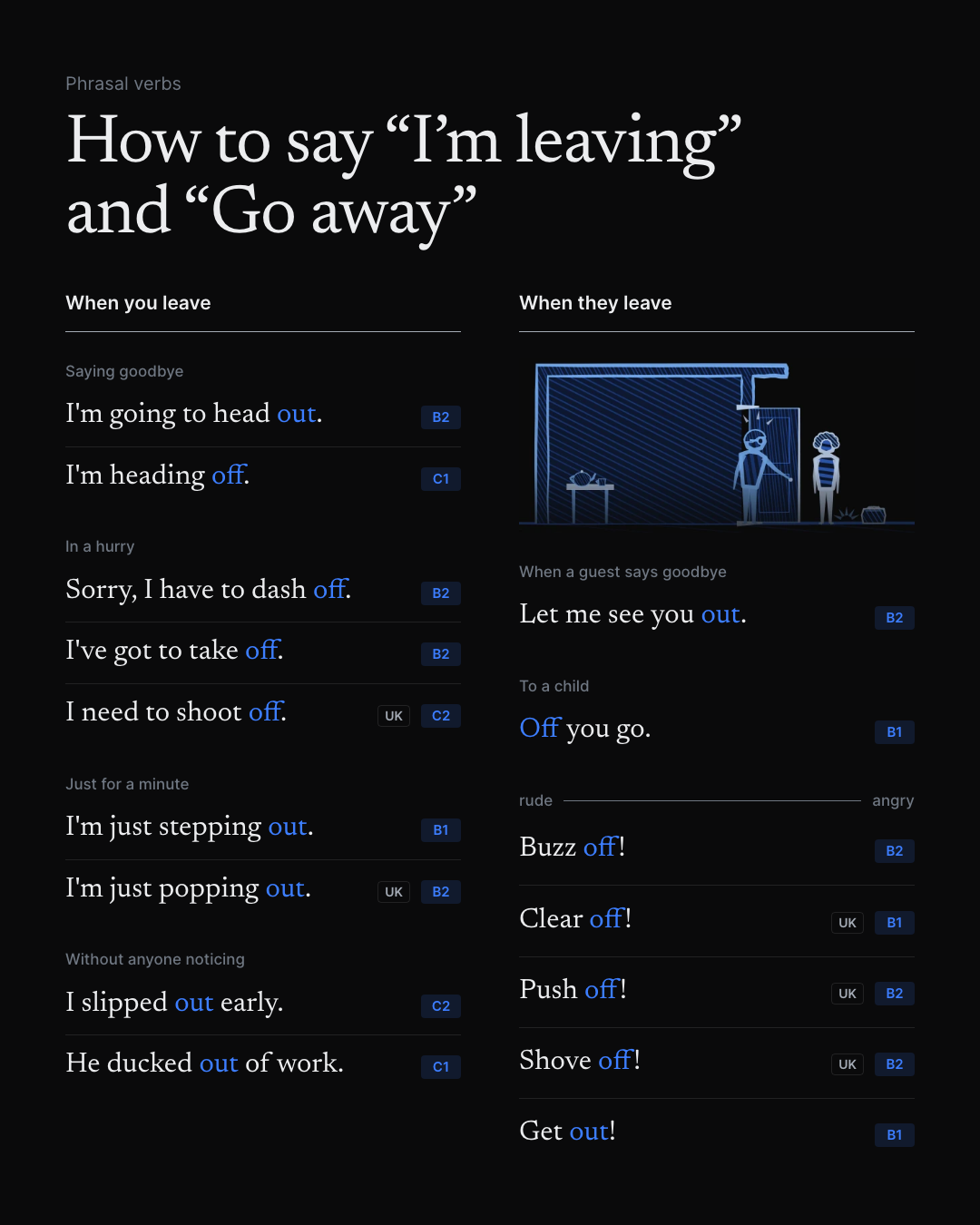
How to say “I’m leaving”
and “Go away”
When you leave
Saying goodbye
I'm going to head out.B2
Leave a place, often to go somewhere next.
“Let's head out before the last bus.”
The most common way to say you are leaving. Fine at work and with friends.
Level B2 (Cambridge)
I'm heading off.C1
Leave a place and start your trip home or to the next place.
“I'm heading off to the station now. See you there!”
Very common in British English. Americans more often say I'm heading out.
Level C1 (Cambridge)
In a hurry
Sorry, I have to dash off.B2
Leave very quickly because you are busy or late.
“She dashed off to catch her train.”
A friendly way to say sorry for leaving fast. More common in British English.
Level B2 (our estimate)
I've got to take off.B2
Leave now, often in a hurry.
“Sorry, I've got to take off. My bus is here.”
Informal and common in American English. Take off has other meanings too, like a plane that leaves the ground.
Level B2 (our estimate)
I need to shoot off.UKC2
Leave quickly because you are in a hurry.
“I have to shoot off. My train leaves in twenty minutes.”
British and informal. Many Americans have never heard it.
Level C2 (our estimate)
Just for a minute
I'm just stepping out.B1
Leave a room or building for a short time, then return.
“I'm just stepping out to buy lunch. Back in ten.”
Common at work. People expect you to return soon.
Level B1 (our estimate)
I'm just popping out.UKB2
Leave for a short time to do something quick, like buy milk.
“I'm just popping out to the shop. Do you need anything?”
British and informal. Pop means go somewhere quickly.
Level B2 (Cambridge)
Without anyone noticing
I slipped out early.C2
Leave quietly so that nobody notices.
“She slipped out of the meeting.”
Often about a meeting, a party or a talk that is still going on.
Level C2 (our estimate)
He ducked out of work.C1
Leave quietly to avoid a job you should do.
“He ducked out before the washing up started.”
Informal, and a little critical. The person should have stayed and helped.
Level C1 (our estimate)
When they leave
When a guest says goodbye
Let me see you out.B2
Walk with a guest to the door when they leave.
“Thanks for coming. I'll see you out.”
Kind and polite, but only after the guest says they are leaving. If you say it first, it sounds like you want them to go.
Level B2 (our estimate)
To a child
Off you go.B1
Tell a child to go and do something, or to leave.
“Off you go to bed. It's late.”
Kind, or a little impatient. To an adult it sounds like you are talking to a child.
Level B1 (our estimate)
Buzz off!B2
A rude way to tell someone to go away.
“Buzz off! Can't you see I'm working?”
Rude, but a little playful. A bit old-fashioned in the US.
Level B2 (our estimate)
Clear off!UKB1
A rude way to tell people to leave a place.
“Clear off. We're closing!”
British and informal. Often said to people who should not be there.
Level B1 (our estimate)
Push off!UKB2
A rude way to tell someone to go away.
“It's late. We'd better push off.”
British. About yourself it is not rude, as in the example. As an order, it is.
Level B2 (our estimate)
Shove off!UKB2
An angry way to tell someone to go away.
“Shove off and leave me alone.”
British, angry and rude. Use it only if you want a fight.
Level B2 (our estimate)
Get out!B1
An angry order to leave a room or building now.
“Get out of here right now!”
Careful: Get out! can also mean I don't believe you! Your voice and face show which one.
Level B1 (Cambridge)
Tap any phrase to see what it means and when people use it. Levels come from the Cambridge learner dictionary where it gives one (4 of the 16). The rest are our estimates. Download this as a picture
Off or out?
Most leaving phrases use off or out. Both can mean leave, but they look at the leaving from a different side.
off
What do you think about? The trip that starts.
Someone or something leaves a starting point: I'm heading off to the station now. She dashed off to catch her train.
out
What do you think about? The place you leave.
Movement goes from inside to outside: from a room, a building or a meeting. I'm just stepping out. She slipped out of the meeting.
When both look possible
I'm heading off and I'm heading out both mean you are leaving. In American English, head out is the usual one. In British English, people say both.
Step out or head out?
Both use out, so both are about the place you leave. The difference is what happens next. After step out, you return soon: I'm just stepping out to buy lunch. Back in ten. After head out, you are gone for the day or on your way to the next place.
Ask one question: will you return soon? If yes, say I'm just stepping out. If no, say I'm going to head out.
See every meaning of off and out in Sink In
Free on iPhone and Android. Every meaning has a short animation, like the ones on this page, and you practise a few meanings at a time.



Without off or out
Native speakers also say these. They are not phrasal verbs, but you will hear them every day.
- I've got to go.
The simplest way. Fine everywhere, with anyone.
- I'd better get going.
Friendly. Good at the end of a visit or a call.
- I have to run.
You are in a hurry. Informal.
- I'll be right back.
You leave for a minute or two.
Be careful with these
I'll see myself out means you can find the door without help. But many people hear it as a little annoyed, as if the host was not kind enough to walk with you. Online, people mostly say it as a joke after a bad pun. To be safe, say Thanks, I can find the door.
Let me see you out is kind after your guest says goodbye. If you say it first, it tells them the visit is over.
Off you go is for children. To an adult, it sounds like you are talking to a child.
Get out! is usually an angry order. But when a friend tells you surprising news, Get out! means I don't believe you! Your voice and face show which one you mean.
Push off is rude when you say it to someone else. When you say it about yourself, as in We'd better push off, it only means you are leaving.
The same verb with another meaning
Some of these phrases have other meanings too. The rest of the sentence tells you which.
take off
- This page “Sorry, I've got to take off. My bus is here.” leave now, often in a hurry
- Another meaning “Our flight takes off at half past three.” leave the ground and begin to fly
- Another meaning “Take your shoes off at the door, please.” remove clothing or accessories
get out
- This page “The driver got out of the taxi.” leave a room, car or building
- Another meaning “The secret got out eventually.” become known publicly, often by accident
clear off
- This page “Clear off. We're closing!” leave a place quickly, often when told to
- Another meaning “Clear the books off the table.” remove items from a surface
- Another meaning “She cleared off her loan in two years.” pay a debt completely
How to ask a guest to leave politely
There is no polite phrasal verb for this. People say it in an indirect way, and the guest understands:
- “Well, it's getting late.”
- “Thanks so much for coming.”
- “I'm afraid I have an early start tomorrow.”
The guest then says goodbye, and you can answer Let me see you out.
Word order: see you out, not see out you
Most leaving phrases have no object: I'm heading off. She slipped out.
See out always has the person in the middle: Let me see you out. Our host saw us out and waved from the steps. Never say see out you.
To name the place you leave, add of: The driver got out of the taxi. She slipped out of the meeting. The manager stepped out of the office.
To name where you are going, add to or for: I'm heading off to the station. Jade headed out for her interview at eight.
Practice: which one would you say?
Pick the phrase that fits each situation. You see the answer after each choice.
It's late at a friend's party. You want to go home.
Thanks for having me. I'm going to .
Answer
head out. Head out is the usual friendly way to say you are leaving. Step out means you will return soon, and slip out means nobody should notice.
Your boss asks where you are going. You will be back in five minutes.
I'm just for a minute.
Answer
stepping out. Stepping out means a short time. Heading out sounds like you are leaving for the day, and slipping out means nobody should notice.
Your train leaves in ten minutes and you are still at the café.
Sorry, I have to !
Answer
dash off. Dash off means leave fast. Slip out means leave quietly, and step out means you will return soon.
Your guest takes their coat and says, "I should go. Thanks for dinner!"
Thanks for coming. Let me .
Answer
see you out. See you out means you walk with them to the door. Say it after they say they are leaving. Push off and clear off are rude ways to tell someone to go.
The talk is boring. You leave quietly so nobody sees you.
Halfway through, I .
Answer
slipped out. Slipped out means quietly and without being noticed. Dashed off is fast, not quiet, and cleared off sounds like someone ordered you to leave.
Your friend says, "I just won the lottery!" You don't believe it.
You did not!
Answer
Get out!. Get out! can mean I don't believe you! Push off and buzz off only tell someone to go away.
Frequently asked
What is a phrasal verb for leave?
Head out is the most common: I'm going to head out. In British English, head off is common too. To leave fast, say dash off or take off. To leave for a short time, say step out. To leave quietly, say slip out.
How do you say you are leaving politely?
Say thank you, then say you are leaving: Thanks for having me. I'm going to head out. or I'd better get going. If you are in a hurry, say sorry first: Sorry, I have to dash off.
Is “I'll see myself out” rude?
It can be. It means you can find the door without help, but many people hear it as a little annoyed. Online, it is mostly a joke after a bad pun. A safer choice: Thanks, I can find the door.
How do you politely ask a guest to leave?
Not with a phrasal verb. Say it in an indirect way: Well, it's getting late. or Thanks so much for coming. When the guest says goodbye, answer Let me see you out.
What is the difference between step out and head out?
After step out, you return soon: I'm just stepping out. Back in ten. After head out, you are leaving for the day or for the next place.
What does “Off you go” mean?
It tells someone to go, usually a child: Off you go to bed. To an adult it sounds like you are talking to a child, so use it with care.
Learn every particle this way
Sink In shows what each particle means, so new phrasal verbs make sense. Free on iPhone and Android, no card needed.